
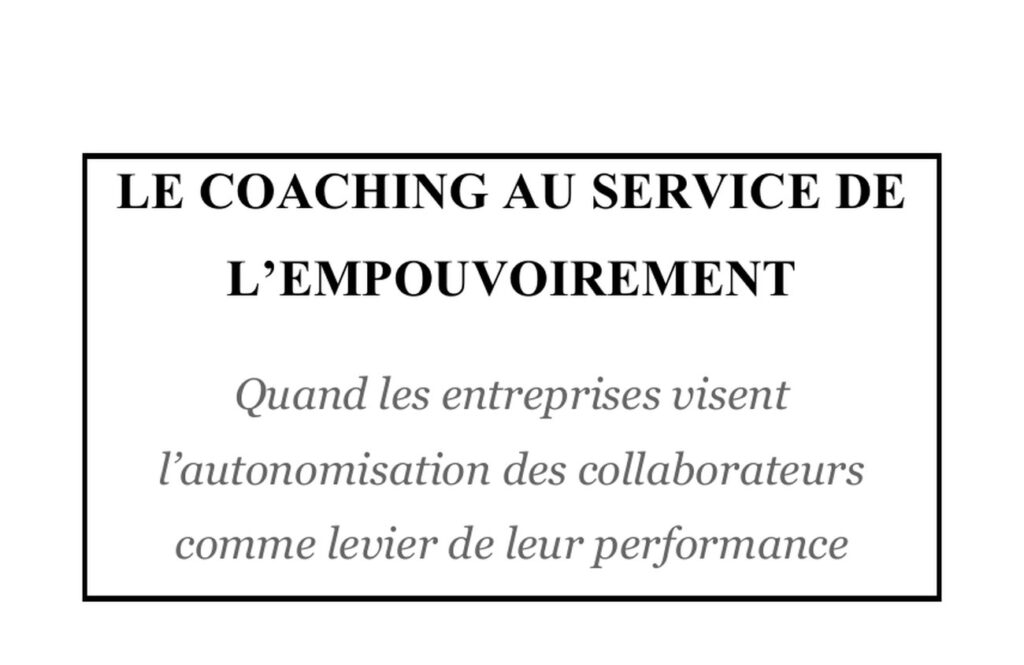
For those with time on their hands: I am sharing my professional coach certification dissertation (RNCP Level 6, Linkup Coaching), defended in December 2024: “Coaching in the service of empowerment. When companies aim at employee autonomy as a lever for their performance”. A subject that has always driven me.
Empowerment: what are we talking about?
Empowerment (in French “empouvoirement”, from the English empowerment) is the process that develops employees’ autonomy by giving them the means to act, to influence their environment and to take part in the decisions that concern them. It is neither simple task delegation nor a reduction in hierarchical control: it is a change in how we see each person’s role in the organisation.
Researchers Spreitzer and Quinn describe it along four dimensions:
- autonomy : the freedom to decide within the scope of one’s role, without systematic approval;
- a sense of competence : feeling capable, with the necessary training and support;
- meaning : useful work, for oneself and for the organisation;
- impact : perceiving that one’s actions really make a difference.
For companies, the stakes are clear: more autonomous employees are more engaged, more innovative and more resilient to change. It is a lever for operational performance, provided you go beyond empty announcements.
The manager, a key player in empowerment
My dissertation shows that managers are the cornerstone of their teams’ empowerment. Hence the importance of the manager-coach. Managers’ most frequent coaching requests show it: knowing how to delegate, giving meaning, inspiring and trusting, listening, showing empathy and emotional intelligence, leading change, finding their position, motivating, leading by example.
Individual coaching helps managers develop these skills, adapt autonomy goals to each team member, and become a kind of coach for their own team.
Two real coaching cases
The dissertation draws on two coaching assignments with managers (names changed):
- Marianne wants to inspire trust : a manager who asked her team for autonomy… while taking back control. The work focused on aligning what she said with what she did.
- Patrice wants to become a supporter rather than a commander : a manager convinced that “nothing will ever change here”. A real improvement in wellbeing, but a reminder that the system matters as much as the person.
Limits and pitfalls
Coaching managers in companies often takes place in a three-way arrangement: the sponsor is not the coachee. This raises ethical questions the coach must be able to handle: not playing a role that is not theirs, not taking sides, defending the framework when the purpose of the coaching drifts. The manager, for their part, has to face their own resistance to change, the difficulty of delegating and the time it takes.
And one question remains open: are companies’ economic logics always compatible with real empowerment? The coach cannot be responsible for the success of employee empowerment, let alone its effects on performance. Their place is to support managers towards their own vision, respecting their own ecology and that of the people they work with.
Read the dissertation
The full dissertation (78 pages, in French) is free to download below. Your feedback is welcome, here or under my LinkedIn post.
How I can support you
Based in Montauban, I support leaders and managers who want to develop their teams’ autonomy and engagement, through individual and team coaching. I work on site in Montauban, in Toulouse and anywhere in France, or remotely by video call.