
A gradual transformation of the job market
The labour market is changing shape. Long structured like a pyramid, with a broad base of low-skilled jobs, a solid middle class and a smaller elite, it now tends to look like an hourglass. This transformation, still discreet for some, is nonetheless well under way and has far-reaching consequences for companies and individuals alike.
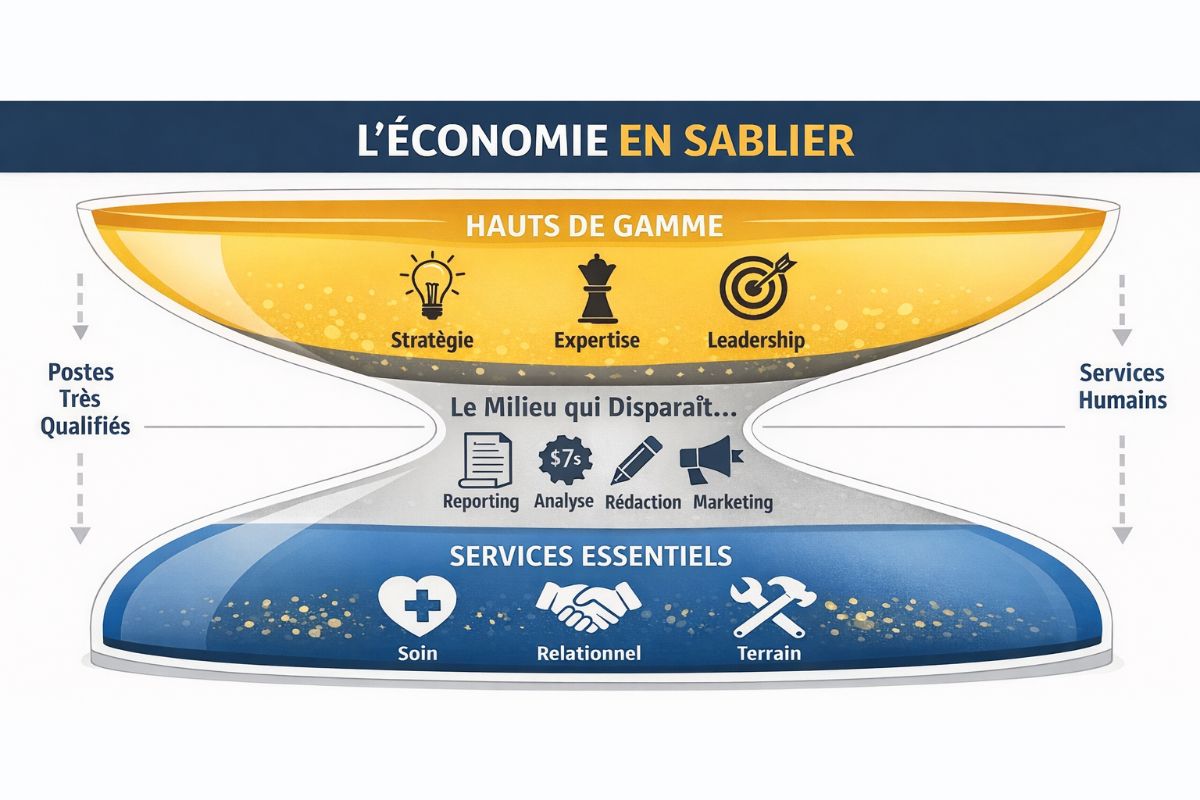
The “hourglass market” reflects a growing polarisation of jobs. On one side, highly skilled positions are concentrating and gaining in value. On the other, low-skilled jobs remain numerous, often with greater insecurity. In between, mid-level jobs, long at the heart of the system, are gradually seeing their place shrink.
Increasingly marked job polarisation
This new structure of the labour market can be read simply:
- At the top: expert profiles, in high demand, able to create strong added value
- At the bottom: execution jobs, more exposed to insecurity
- In the middle: mid-level jobs that are weakened and fewer and fewer in number
This polarisation is profoundly transforming the traditional balance of the job market and calling into question the stability of career paths.
The root causes of the “hourglass market”
Several dynamics explain this trend. Technological change plays a major role. Automation and artificial intelligence are taking over a growing number of structured tasks, often associated with mid-level roles.
At the same time, globalisation is increasing cost pressure and pushing companies to streamline their organisations. In this context, they favour either experts who can make a difference or flexible operational profiles.
Concrete impacts for companies
For companies, this shift calls for rapid adaptation. Recruitment is becoming more demanding, particularly to attract rare and strategic skills. Retaining talent is becoming more complex, in a context where the most qualified profiles are also the most mobile.
Organisations are also moving towards more agile structures, with fewer intermediate levels. This transformation is profoundly changing management styles and internal balances.
Career paths to be reinvented
For employees, careers are becoming less linear and more uncertain. Acquiring skills at the start of your career is no longer enough: continuous learning and building distinctive expertise are becoming essential.
The main risk is remaining positioned in this weakening middle zone. Conversely, those who manage to reposition themselves gain in employability and in their capacity to progress.
The role of professional coaching in this context
In a changing environment, professional coaching stands out as a particularly relevant lever. In particular, it makes it possible to:
- Clarify your positioning and better understand your value on the market
- Build a coherent career path
- Strengthen your ability to adapt and make informed choices
It thus helps individuals take ownership of their career path.
Towards a new relationship with work
Beyond skills, our relationship with work is also changing. The model of the stable career is gradually giving way to more dynamic paths, made up of transitions and adjustments.
The contract between companies and employees is changing, with increasingly shared responsibility for professional development and adapting to change.
Conclusion: adapting to a changing market
The hourglass labour market may raise concerns, but it also opens up new prospects. It values expertise, encourages continuous learning and favours more personalised career paths.
In this context, the ability to evolve, learn and reposition yourself becomes essential. More than a constraint, this transformation is an invitation to rethink your career path in a more active and conscious way.
Taking stock of your career path
Based in Montauban, I provide individual coaching to professionals who want to clarify their positioning and prepare a transition, as well as to managers and HR teams who need to adapt their organisation and their organisational culture. I work on site in Montauban, in Toulouse and anywhere in France, or remotely by video call.