
Faced with a team in difficulty, the reflex is almost always the same: diagnose what is wrong, then fix it.Appreciative Inquiry proposes exactly the opposite. Instead of dissecting problems, it gets the group to tell the story of its successes and builds on its strengths to create the future it wants.
In late October 2026 I trained in this approach with theFrench Institute of Appreciative Inquiry (IFAI), in Toulouse. Here is what it concretely changes when supporting a team or an organisation, in Montauban, in Occitanie or remotely.
What is Appreciative Inquiry?
Appreciative Inquiry is a change management method that emerged in the late 1980s at Case Western Reserve University (Cleveland), around David Cooperrider. It rests on a simple idea: in every organisation, something already works. It is by exploring this “positive core” that the group finds the energy to change.
The word inquiry means investigating, questioning. So being appreciative does not mean “thinking positive” at all costs. It means asking questions that help people remember what has already worked, and imagine what could happen.
A break with problem-centred approaches
Traditional approaches start from a gap: a malfunction, an indicator in the red, “resistance”. At best, they bring a team from negative back to neutral. Appreciative Inquiry aims further: towards what the group really wants to become.
- Questions shape the answers. Asking “what’s getting stuck?” produces complaints. Asking “tell me about a time when this really worked well” produces resources.
- Words shape reality. We get rid of terms that conceal a weakness, such as “improve”, “optimise” or “reduce”. In one workshop, the theme “workplace safety” became “going home without a scratch and without a worry”. Same subject, different energy.
- An ambition rather than a corrective goal. A problem “starts from”; an ambition “moves towards”. A good ambition is desirable, attractive and positive.
The problem is not denied: it is acknowledged, and then we ask “once it is solved, what does it look like?”. It is not ignored; it is transcended.
The 5-D method in practice
The approach unfolds in five phases, carried out with the group rather than for it:
- Definition : the sponsors formulate an ambition, which a representative project group enriches and breaks down into themes to explore.
- Discovery : in pairs, each person tells the story of a successful experience related to the theme, the strengths they drew on and what gave them satisfaction.
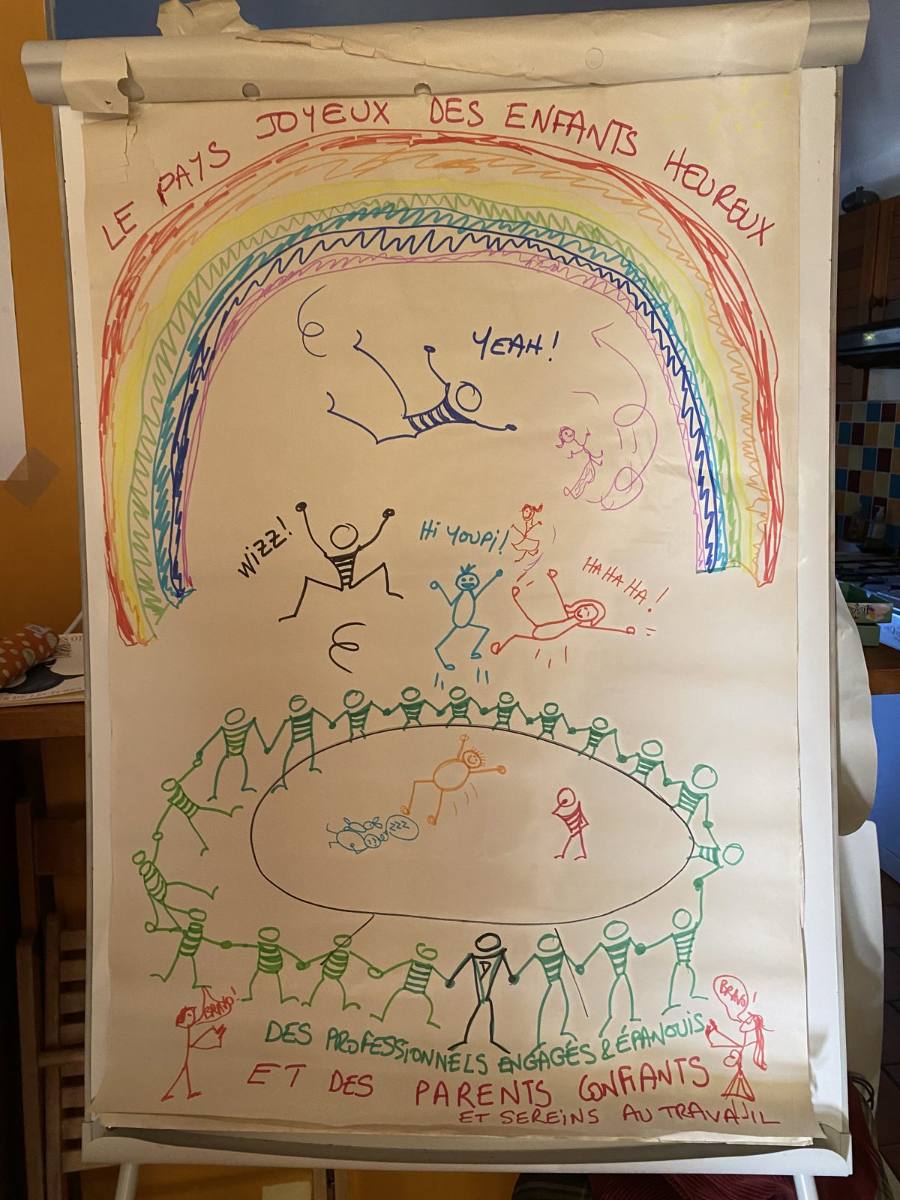
- Dream : the group imagines its desired future and makes it visible (drawing, mural, model).
- Decision : ideas become concrete actions, prioritised and agreed upon.
- Deployment : the group implements, learns and celebrates its first successes on its own.
The Discovery and Dream phases can fit into a single collective day : interviews in pairs, a “coat of arms of strengths” made at each table, then a drawing of wishes presented like an art gallery opening. Leaders often discover their teams in a new light.
When should you use it?
- strengthening team cohesion ;
- supporting a team through change or a reorganisation;
- getting through a minor collective crisis ;
- opening up a space for creativity and innovation.
It also has its limits: when a group is locked into negativity, or facing a decision that has already been made, such as a site closure, the approach does not apply. Saying so frankly is part of the job.
Appreciative Inquiry and SteadyChange: two complementary perspectives
In my assignments, I link Appreciative Inquiry with SteadyChange, the approach developed by Patrice Fornalik, for which I am Lead Ambassador. Both refuse to look at change through the lens of the problem or of “resistance”: people do not resist change, they resist the perceived threat to what matters to them.
Appreciative Inquiry brings out the desirable future from the group’s strengths. SteadyChange helps name the Essentials to preserve and translate them into concrete watch points, so as to evolve without losing yourself. Strengths to move forward, markers to hold your course. It is also a natural extension of what I wrote about how to make organisational culture evolve during a transformation.
Frequently asked questions about Appreciative Inquiry
Is Appreciative Inquiry positive thinking?
No. It is a structured questioning approach. Difficulties are acknowledged, but we look for resources in what has already worked rather than in analysing the causes of failure.
How long does an appreciative process take?
It depends on the ambition. A simple intervention with a small team can fit into a half-day scoping session and one collective day. An organisational transformation spreads over several months.
Can an appreciative process be run remotely?
Scoping with the sponsors and the project group works very well by video call. The interviews and the collective day, however, are best held in person, in Montauban, Toulouse or at your premises.
What if your next transformation started with a simple question: what is already working for you? Discover my coaching and organisational transformation services, or contact me to talk about it.